Tuesday, June 23, 2015

TED Talks

Like many people, I've spent hours shamelessly pouring over the internet (in fact I'm writing this at 12:06 AM because who needs sleep) and all it has to offer. I've definitely spent my fair amount of time watching silly cat videos on Youtube or scrolling through Pinterest. However, the internet is also an amazing learning tool if you decide to make it. Before you nag me about how you already do enough learning in school, let me preface this post by saying the internet is a different type of learning. It doesn't have to be used to learn algebra or how to conjugate verbs properly, but rather it should be used to explore your interest, to inspire you, to make you think critically and question, which is something a school education might try to do, but will never fully accomplish. Oh, and some of the stuff online is just really freaking cool.

TED talks are one of my favorite online hubs to watch. TED stands for technology, education, and design, and the website features hundreds of lectures by prominent movers and shakers in fields ranging from sociology to botany. The goal of these talks is to inspire and to challenge people to think. There are definitely issues with TED, such as that it grossly over simplifies complex ideas or that it's an superficial, ego building machine. Despite this, there are several TED talks that I've found truly inspirational or that have challenged my mental paradigm, and those are talks worth spreading.

Uri Alon: Why truly innovative science demands a leap into the unknown


Uri Alon pinpoints exactly what's missing from the education most kids grow up with: mistakes aren't just okay, they're necessary. Education, from its setup to its goal, describes life as a straight path from A to B; if you work hard and never sway, you'll always succeed. Failure is discouraged. Yet failure has spawned some of the most important modern discoveries, such as rubber. Alon stresses that failure is the source of the most creative and useful scientific results. It was in improv classes that he learned how to cultivate an undesirable position into a success, which he later applied to his research. Just as this lesson is applicable in both science and improv, it's applicable in every facet of life.

Julian Treasure: How to speak so that people want to listen


Whether or not you see yourself becoming a politician or an engineer, you will pretty much always have to interact with people on a face to face level. You might as well be good at it then! Regardless how talented or creative you are, your ideas are worthless to others unless you can convey their importance verbally.  My Model UN coach used to show us this video halfway through the season to help us refine our speaking styles, and it definitely helped. Julian Treasure breaks down how to be an effective speaker and his tips are applicable to both public speaking as well as one-on-one conversations. 

Cameron Russell: Looks aren't everything. Believe me, I'm a model.


Like many young girls, I dreamed of being a princess or a model (that is, until I stopped growing at 5' 3"). Cameron Russell, a successful model and globetrotter, breaks down the picturesque perfection of being a model and the fashion industry in general. She points to the unjust racial and economic legacy that the industry relies on, as well as the needless sexualization of young girls for the sake of a good picture. Her main point is that images are powerful; we base our thoughts and beliefs off of pretty images, yet those images are constructed by teams of professionals to send that particular message. When we look beneath the image, things are no longer as pretty as they seem. This not only pertains to the modeling industry, but to any situation worldwide.

Helen Fisher: The brain in love


This is a talk I've watched over and over again and still manage to enjoy it. It's not as "educational" as many other TED talks, but somehow, it still resonates with me. I think I'm just drawn to Helen Fisher's honest, romantic, and idealistic description of love, and with due reason of course. As Fisher describes, our brains are programmed to crave romantic love despite knowing the pain that love can cause. In a world of climbing divorce rates and cynical statements that love is futile, it's a nice, hopeful reminder that all humans need love, so hopefully you'll find it. 

Chimamanda Ngozi Adichie: The danger of a single story


You may have heard of Adichie's other TED talk that perhaps Beyonce might have quoted, so I decided to give this one a shout out. In this talk, Adichie describes the pervasiveness of stereotypes and how they flatten both the human and the individual experience. Everyone is more than just a single story imposed on them by someone else's imagination. When we get past the single story to see who people really are, we eliminate the hatred and bias that governs so many of our interpersonal relations today. Eliminating the single stories that we impose on discussions of race, class, and gender, are the first step to living in a much more equitable society.

Those are my favorite TED talks. Share your favorite TED talks with me on social media using #theyouthemisms! 

Friday, June 19, 2015

Feminism: An Introduction

Fox
I've blogged about feminism before, but I feel like I threw you guys into this without a proper introduction. Hi, I'm Steph, and I'm a feminist! Hopefully, you are too, even if you don't know it yet! But in case you aren't swayed, or just don't really know what I'm talking about, here's a concrete introduction to feminism.

What is feminism?
Feminism is defined as:

a) The theory of political, economic and social equality of the sexes;
b) Organized activity on behalf of women's rights and interests.


Giphy.com
If you believe in either of those things, then congratulations, you're a feminist! Come, join us! We have gender equality and cookies!

What is feminism not?
Basically, if it's not included in the definition above, it's not feminism. There are haters who claim that feminism's goal is female supremacy. This is not true. Do not listen. Female supremacy is just the polar opposite of the male-dominated world we live in now; it doesn't create any sense of equality!

One of the most ubiquitous myths about feminism is that feminism is the same as man hating. Again, this couldn't be farther from the truth. Feminists don't hate men. We simply hate that for so long we've been seen as inferior to men, and sometimes we get a little bit frustrated with that. And honestly, sorry if your feelings get hurt, but a few people hating men is pretty benign and not nearly as harmful as what happens when people hate women.

Wait, so do feminists hate men or not? 
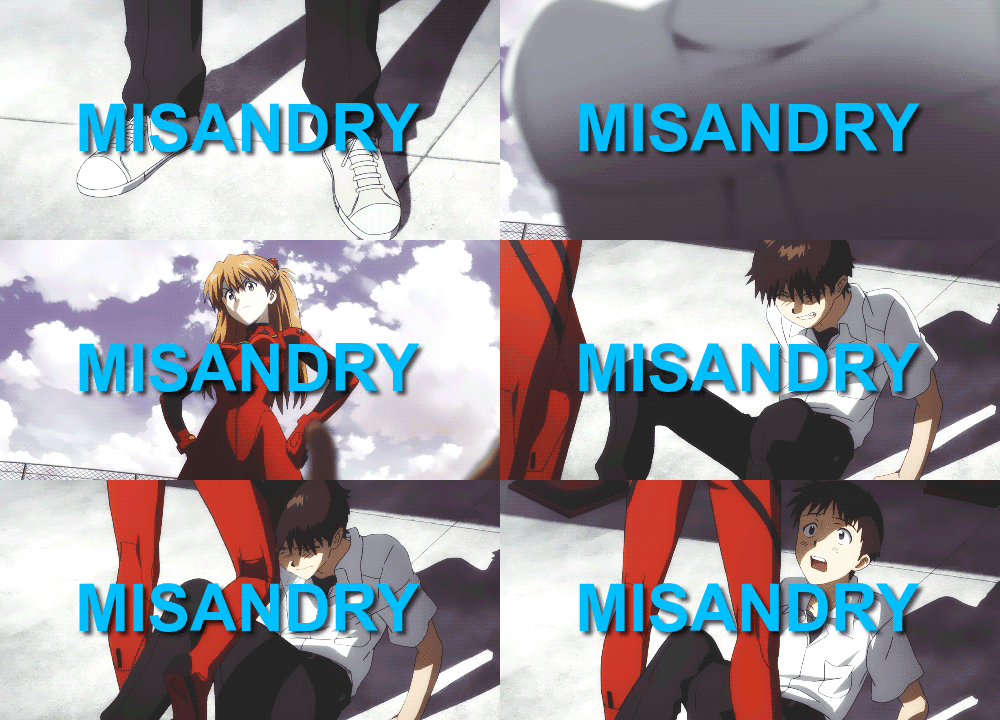
Basically, if you've seen any of these or these products floating around, you're witnessing the ironic, satirical beast that is the hipster feminist. It's all just harmless play and part of the ironic misandry movement. The objective is that by exaggerating accusations of misandry, we show how ridiculous these accusations are.

Via male-tears.tumblr.com
Who can be a feminist?
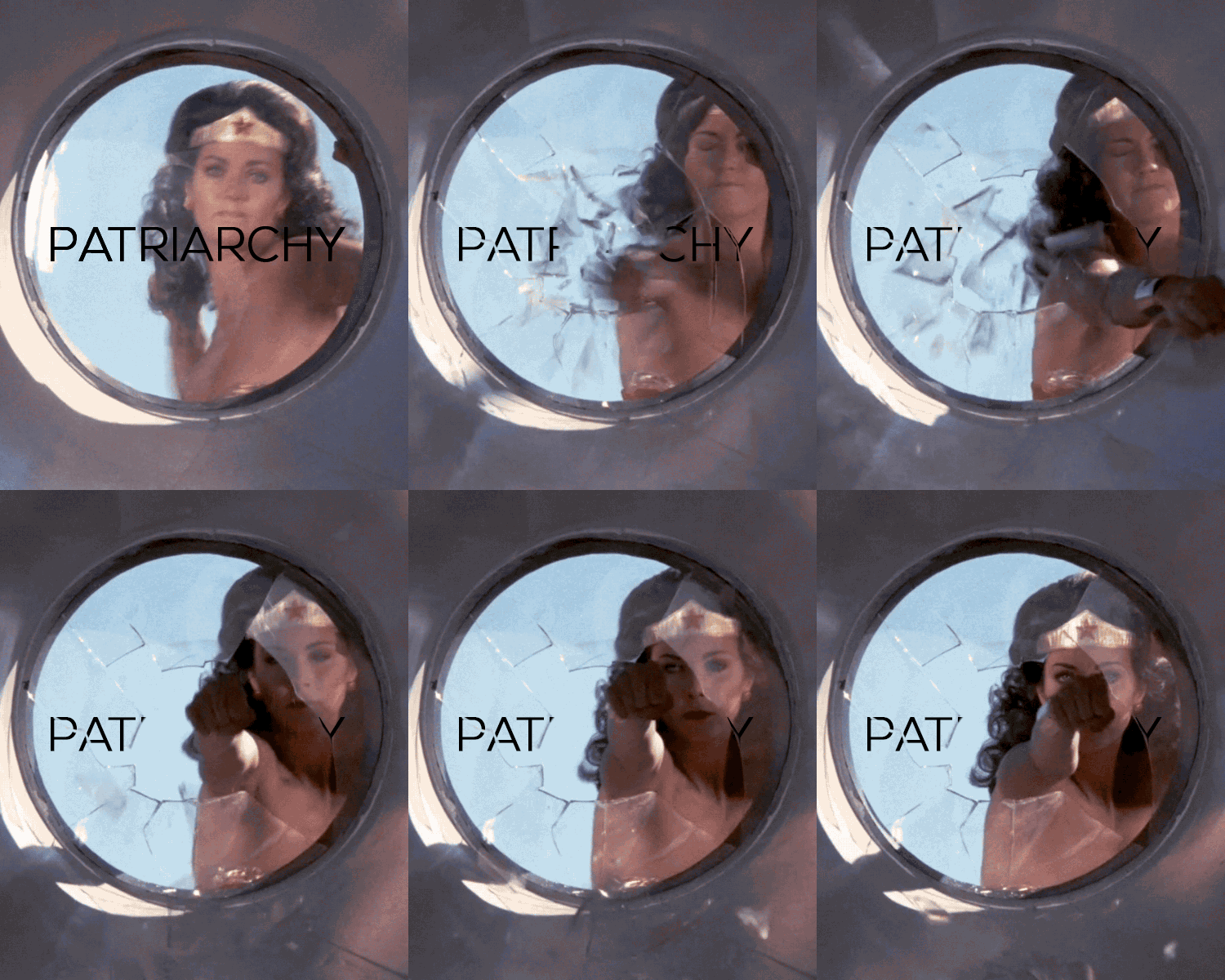
Anyone can be a feminist! You don't have to be female-identifying or fall into any other category. If you're a guy, don't worry, there are plenty of male feminists out there and we need more to help destroy the patriarchy.

Speaking of the patriarchy, what is it?
The patriarchy is fancy talk for the male-dominated society that we live in.

Wait, but it's the 21st century, does the patriarchy really still exist?
YES! In the US alone, there are only 20 female senators, 1 in 6 women will either be raped or be the victim of attempted rape, and women are still habitually underpaid compared to men. And this is in the US, a pretty developed country. Things are even worse when you go abroad to countries where girls get married as young as 13 and where genital mutilation is still practiced. This is why we still need feminism; there's progress to be made virtually everywhere.

Via jessicavalenti.com


What's intersectionality?
Intersectionality is a term feminists use to describe the unique experiences and identity of a given individual. For example, the experience of a queer black woman will undoubtedly differ from that of a cisgendered white woman. All of these different experiences are  incredibly important, so when we talk about feminist issues, we have to keep identity in mind. In turn, this makes things such as race/ethnicity, socioeconomic class, and sexual/gender orientation feminist issues because all of those things impact women.

This is my quick intro to feminism. I hope you discovered that you're a feminist! I definitely didn't go into great detail or depth, but this is just an overview. I definitely want to continue with some of these posts exploring contemporary social issues as I think it's important to discuss these things at a young age and to be an informed citizen. Let me know if you found this post helpful or want to see more posts like this either in the comments below or on social media using #theyouthemisms!


Tuesday, June 16, 2015

Evil Eye Manicure


I love a fancy manicure (though to be honest I rarely have the patience to do one). With the Evil Eye trend taking off in the past few months, I thought where else to immortalize it than on my fingernails?


The Evil Eye is a symbol that originated in the ancient cultures of the Mediterranean and the Indian sub-continent. In Judaism specifically, it's defined as an individual's ability to bring malice upon someone else simply with a gaze. The Turks extend the concept of the Evil Eye to eye color, saying that an unusual eye color is a sign of wickedness, with blue eyes being considered the most deceptive. Turks carry special pendants to protect themselves from the Evil Eye called Nazar Boncugu, which are made out of an amalgamation of molten glass, iron, copper, water, and salt. These are the famous blue circular pendants that populate tourist areas and have penetrated Western culture. Evil Eye pendants are also frequently part of the Hamsa, a Jewish and Arabic symbol shaped like a hand that is meant to protect from the Evil Eye as well.

Hamsa (Left) and Evil Eye Pendant (Right), courtesy of levantinecenter.org
Between the Hamsa and the Evil Eye pendant, many fashion houses from Kenzo to Urban Outfitters have used these symbols as an inspiration for recent fashion seasons.

Kenzo Fall 2013, courtesy of The Fashion Bomb Daily
Now I'm going to take my own inspiration from this ancient symbol an put it on my nails. Before starting a fancy manicure, I usually follow these steps to get a high quality manicure at home (and because it just feels luxurious). 

Sally Hansen Double Duty Base and Top Coat, Sally Hansen Hard as Nails Xtreme Wear in white, Sally Hansen I Heart Nail Art Pen in black, Wet n' Wild polish in Putting on Airs, Julep polish in Kelsey
For this manicure, you'll need a base and top coat, nude colored nail polish, white nail polish, a black nail pen, either light or dark blue nail polish (whichever works best with the shade of nude you're using), scissors, a bobby pin, and five bandaids.


Start with clean, dry hands. Paint a light base coat onto nails.


Paint a single coat of white nail polish on. Don't worry about getting a super opaque or even color as we'll be painting over most of the white later. Make sure your nails are completely dry before moving on to the next step. In the meantime, read a magazine or catch up on Netflix.


Cut the bandaids in half. You should have 10 half-bandaids, or one for each finger.


Stick the bandaids on your nails, approximately covering 1/3 of your nail.


Paint the nude nail polish over the bandaids.


Peel the bandaids off. You should get lovely white half-moons on the  bottom.


Pour some of your chosen blue nail polish onto a piece of paper. Using the tip of a bobby pin, paint a rectangular stripe running from the nude to the bottom of your nail.


After letting the nude and the blue color dry for a bit, draw on some eyeliner, three eyelashes, and the pupil using a black nail pen. Let this dry, clean up the edges with a q-tip and some nail polish remover, put some top coat on and voila! You're done!


Friday, June 12, 2015

Thoughts on Graduation


And I'm writing this... off my new Macbook Pro! I've successfully become a walking, talking, Apple advertisement.

If graduation means getting a new laptop, I should seriously graduate more often.

This past Sunday, I graduated from high school. It was a flurry of emotions, some good some bad. Most of them consisted of me being annoyed that I had to sit for three hours and that the graduation cap was seriously messing up what could've been a good hair day. Or being annoyed at the incessant amount of photos my parents demanded. But at the end of it all, it was a good day. I received my diploma, spent quality time with my family and then with my friends at grad night, and had a chance to say goodbye to the teachers and administrators that impacted me the most.


We have an unofficial tradition of going to the beach the following morning and watching the sunrise
Graduation to me didn't seem like a huge deal. From the moment I stepped into the halls of my high school, it was pretty much set that I would graduate. But that's because I attended a well-off, suburban public school. That's not the case for everyone. The high school class of 2013 set the graduation rate record at only 81%, and this is factoring in schools like my own where everybody will graduate. The disparities persist, however. A third of low income kids do not graduate, racial minorities and English language learners have significantly lower graduation rates, and some states still have graduation rates as low as 33%. I'm not here to be a giant cheese bomb, but a high school diploma is truly a blessing and it shouldn't be taken lightly.

My high school diploma is setting me up for the next four years of my life, aka college. And that's terrifying. I'm supposed to have the next four years figured out and I don't even know what I'm having for lunch today. And I have to do that far away from the people I love.

My aunt and me (left); my mom, my dog, and me (right)

I'm scared because I've basically spent the last four years surrounded by the same people in a concealed learning environment. Most of the people I know are going to different schools that are mostly located really far away from where I'm going to school. It was hard enough making friends in high school, but it's even harder as an adult when you're transplanted to a new location where you know nothing and no one. I'm still home for the summer, but even so I'm already starting to anticipate the isolation of being away.

Next fall, I'm attending Yale University. I'm so incredibly excited for the amazing opportunities I'll get while at Yale and I'm glad my hard work in high school payed off. But like I said, Yale's far away, aka 886.6 miles. I'm lucky that one of my best friends is also attending Yale next year, but even so, a weekend trip home isn't really an option on a college budget. I'll have to get used to seeing my dog (oh, and my parents) only via Skype.


Me and Lauren, my sister from another mister, and a fellow Yalie

The other thing that I'm scared about for Yale is its rigor and caliber. The classes are going to be hella hard, and everyone around me is going to be hella smart. I do think that that's the right environment for me, but it'll definitely be a new feeling to not necessarily always be at the top academically anymore. As the common adage goes, the only way to improve is to surround yourself with people who are better than you. Ultimately, that's why I wanted to go to such a competitive school. However, it'll still be quite an adage to go from being a big fish in a small pond to a small fish in a big pond.

Graduation and getting ready for college definitely remind me that I'm not really a "kid" anymore. I'm technically an adult and I have been one for a few months, but it's really starting to sink in as I'm learning how to be on my own. That made me ask myself, am I young enough to be writing this blog? Does being young transcend the legal age of 18? After some thought, I think it does. Hell, Tavi Gevinson is older than me and she's still editor of Rookie Mag! I think being young is more being new, being inexperienced, still trying to figure things out. And young can last a pretty long time. It's all about how you feel, and I have no intention of aging myself quickly.

That was definitely a more personal post than normal, but I wanted to share my thoughts in hopes that maybe someone else feels this way too, and it's always nice to find a kindred soul. If this post did resonate, let me know, but mostly, thanks for reading and empathizing :)

P.S. Maybe in 10 years this blog will be called Adultisms!

Tuesday, June 9, 2015

Bad Feminist


Here is the book that is a New York Times best seller, just went into it's 12th printing cycle, and is the UCLA class of 2019 common book. And for some reason it took me almost a year after its publication to read. 


Gif via giphy.com

One of my close friends and I were perusing a Barnes and Noble recommended reads bookshelves when we saw the book. The words "bad" and "feminist," for two self-proclaimed feminists like ourselves, are trigger words, automatically commanding our attention. We debated getting one copy and sharing, and then we realized that we wanted to read it simultaneously in order to discuss it. Definitely worth the $15.99 wallet drain.

Bad Feminist is an acclaimed book of essays by the writer Roxane Gay. Published in August of 2014, the book has catapulted Gay into the public eye, with appearances at prominent events such as TED Women, several writing festivals, and interviews with the likes of the Huffington Post. We're all bad feminists: let's be real, nobody's perfect. We just operate under the facade of being perfect feminists, perfect women, perfect humans, and use that perfection to marginalize those that openly aren't perfect. It takes gumption to break from that mold, to point out the flaws in oneself and others, and Roxane Gay does so masterfully and compassionately. 

The book is split into sections: Me; Gender & Sexuality; Race & Entertainment; Politics, Gender & Race; and Back to Me. Despite these categories, the essays remain intertwined, giving the book the feeling of one cohesive whole. Much of Gay's critique relies on discussing literature and entertainment, such as The Help, to describe many race, gender and class issues she notices in society. What is unique about Bad Feminist in regards to other essays is Gay's unique, pensive voice that permeates every page. Gay relies on her perspective as a (sometime) queer black woman to articulate society's marginalization of her demographic as well as other groups. However, despite Gay's every right to be angry with those who've contributed to the marginalization of voices like her's and others, Gay retains a compassion and empathy for nearly everyone, noting that the oppressed is just as imperfect as the oppressor.

Bad Feminist explores the notion of imperfection and how that impacts every facet of identity and society. In a society that demands perfection, it's hard to point out the structural flaws that keeps us from attaining it; it's hard to admit that we aren't already there. Gay herself admits she pretty much falls outside America's definition of perfection, so instead she uses that position to embrace imperfection. Bad Feminist simultaneously is poking at Gay's own issues at being a feminist (one that finds the song "Blurred Lines" fairly catchy and loves reality TV) as well as feminism's larger issue of excluding non-heterosexual, cisgendered, white women. What Gay does is lets us see the fractures in a functional, albeit slightly terrifying, society. Just like the institutions of American society, she articulates how a person can both be broken yet visibly fine, and how these are the kinds of things we need to actively point out for us to fix the general inequity that governs American society.

Gay's voice is so powerful because of her gleaming compassion. As my aforementioned friend, Sarah, described, "I like [Gay] because she's radically feminist but also radically empathetic." (She also attributed that quote to the book itself, but with both of us combined we still couldn't find it online or in the book so I'm attributing it to her.) Gay doesn't have an obligation to be compassionate to any man in her critiques of gender, any white person in her critiques of race, any heterosexual cisgendered person in her critiques of sexuality, or anyone with a combination of those traits. But she is. She doesn't flatten the oppressor into just those traits. As a cis, hetero, white person (aka me and lots of others), it's definitely easier to read literature that is nice to white people and praises them. However, such literature shouldn't be written to make us happy; it should be written to inflict change. Gay doesn't flatter white people or men or anybody really; what Gay does is she reminds us that beneath our different identities, we're still all human, so let's treat each other as such.

Bad Feminist is definitely one of my favorite non-fiction reads. It's not too long, it's captivating in its subject matter, and its voice is remarkable. You don't have to be a feminist (though you should be a feminist) or a lofty academic to read and enjoy this book! I hope my pseudo-review/analysis is enough impetus to go pick it up from your local library or bookstore, so if you do, make sure to either comment below with your opinions of it or use #theyouthemisms on Twitter and Instagram to share your opinions!


Friday, June 5, 2015

Summer Updates

So if you've decided to delve into the archives of this here blog between 9 PM and 8 AM central time, you might have noticed a few changes. Namely, a more unified blog structure (i.e. font and picture sizing) as well as an embedded Twitter and Instagram feed (follow me!).

Yes, I made some updates. I technically started this blog for my senior year English class, but I graduate from high school in two days (scary, right?!) and I want to continue blogging because I really enjoy it. I want this blog to be my creative outlet, and for that I need it to have a productive and uniform design.

I also want to take the writing side more seriously. I've set a pretty ambitious blogging schedule so far. For at least the month of June, expect a new blog post at 8 AM central time on Tuesdays and Fridays. I'm apologizing in advance if I miss a post; I'm still pretty new to the idea of committing myself to creating new and original content so this is quite a challenge for me.

I'm also expanding the scope of my blog. Now that I'm no longer limited by class requirements and tedious school rules, I'm free to blog about whatever fluff I want! That means fashion/beauty posts, DIYs, entertainment/fun posts, and a slew of other things never before seen here. I'm super excited for them, I hope you are too!

Well, that's all I have to say for now. Bring it on, blogosphere!

Thursday, May 21, 2015

A Healthy Dose of Narcissism

Narcissism (n): inordinate fascination with oneself
Synonyms: self-confidence, self-love, self-admiration


Everyone says that narcissism is bad. I disagree. I believe that a small dose of narcissism a day keeps the self-hate away. The word, despite its overtly negative definition, is synonymous with self-love and confidence; why wouldn’t we want to have those traits?!

I tell everyone I can that a spoonful of narcissism makes the tough days go down. Because when everything goes wrong, no one will be there for you except yourself, and you’ll want to be there for yourself too.
Want to be happy like Mary Poppins? Try narcissism!
I say this because like any teenage girl, I’ve suffered through my fair share of emotional rollercoasters. I’ve dealt with falling in and out of love, losing friends and making new ones, body image contortions, and just the general problem of trying to grow up without losing sight of myself. Through all the thick and thin, sure I’ve cried on my best friend’s shoulder a few times, but no amount of chocolate or therapy sessions with my bestie worked as well as just being able to believe in myself and love myself.

It’s simply not sustainable to derive your happiness and confidence from others because there’s no guarantee they’ll always be there. That doesn’t mean your friends shouldn’t make you feel like you’re on top of the world; on the contrary, good friends should build you up and bring out the best in you. But we accept the love we think we deserve, and if you don’t love yourself, you won’t find that love in other people. Love yourself unequivocably and don’t be afraid to flaunt it.

This is hard advice to swallow as a teen, especially in a society that holds people to an unattainable level of perfection. I’ve struggled with this too, teetering into the realm of self-loathing on occasion. I get it, everyone has a tough day every now and then that’s hard to bounce back from. It’s important to remember that the goal isn’t to be pinacle of confidence every day but rather have the self-respect to deal well with the bad days and the self-confidence to beam on the good days.
Don’t be afraid of doing little things for yourself, both public and private, to show yourself some love. I love taking selfies (seriously just take a look at my Instagram). I definitely have way more selfies in a folder on my phone than I have on social media though. Those selfies are there just for me, to look at and say, “damn, girl, I’m hot!” I also have a jar of “encouragements,” or little slips of paper that have cheesy inspirational quotes or things I love about myself. If I’m ever feeling down, I take my pick from the jar and remind myself of why I’m awesome. Little things like cultivating a sense of style that makes you feel confident or taking an extra half hour to have a bubble bath at night are small ways to show yourself you care.
Told you I'm the selfie queen. Welcome to my store of never before seen selfies.

At the same time, remember that this is a healthy dose of narcissism. The ancient Greeks believed that from every virtue stemmed two vices. Don’t let this virtue turn into egomania. There’s a distinct difference between being confident and being arrogant. Arrogance, quite frankly, is one of the biggest turn offs, and will only hold you back in life rather than propel you forward. I’d say the best way to be grounded is to recognize the awesomeness and merit of others, especially the peers that surround you on any given day. It’s humbling to see your classmates do or say amazing things and they’re the ultimate connection to Earth. Like I said, just a dose.

To basically summarize the advice from the 612 words (yes, I'm very verbose) above, love thyself and care for thyself as thou would care for others. Don’t confuse this with believing that you’re the supreme being on planet Earth; that just makes you a douchebag. But seriously, if there’s one thing I wish people told me before going into high school it would be to take better care of myself on a physical and emotional level. It’s really easy to get caught up in the pressure of maintaining a social media-worthy social life, good grades, and sleep and sometimes I think we all forget that it’s not the activities that matter but the person who does them. So take good care yourself (points stern finger at reader)!

As I finish my last few weeks of high school (eek), I’ve realized this is my biggest takeaway going into college. Not to sound sappy, but high school was definitely a journey and I hit some rough patches along the way. If I’d had more faith in myself, I might have been able to handle those a little bit better. Next year, I’ll be living 886 miles away from home and I’ll pretty much be on my own. In navigating the new friendships and relationships I’ll have in college, I want to remember that I am my own best friend, and treat myself as such. 

I hope anyone who reads this takes this advice. It’s so basic and seemingly obvious, yet it’s something that most people eliminate from their daily mantras. If you ever do take a little narcissism to heart and share it on social media, be sure to use #theyouthemisms so that I can see it! Good luck, chickadees!