Tuesday, March 3, 2015

Feminism

Photo from Beyonce, via urbancusp.com
Step back cause there’s a new F-word in town. I’m not talking about f@*!, I’m talking about feminism. That’s right, your favorite group of bra-burning, man-hating girls is back with even hairier armpits and grittier campaigns. The word “feminism” to us millennials has been so contrived by current culture and media that the movement and word itself share little in common with its origins. Yet despite the evolution of feminism over time, the word carries so much baggage so as to prompt writer and editor Martin Daubney to say, “Few other words in the English language instil such an immediate, powerful and usually negative response in men (and, interestingly, quite a lot of women) as the F-word.” With more and more people announcing their stance on feminism, it only feels fair that the use of the word “feminism” gets its exploration here too.


Feminism in definition: In definition, feminism is “the belief that men and women should have equal rights and opportunities.” Such a shocker that someone’s radical enough to believe that women are people too.


Unfortunately, this definition is frequently lost in everyday conversation. The conversation around feminism now centers around much more than just the movement for women’s rights, such as fighting for the voice to fight for women’s rights.


Feminism in History Class: This is the extent of a feminist education that most young men and women are receiving today, unless a student takes a particular interest in the movement early on. History class treats the word “feminism” as an antique meant to be studied from a distance. The AP US curriculum doesn’t even list race and gender as an important theme in US history. In US history, feminism is taught through a series of disjointed events and people, starting with Elizabeth Cady Stanton and largely ending with Susan B. Anthony and the Suffragettes (hello, what happened to Betty Friedan and the entire 20th century?). This educational approach renders feminism as a dynamic, continuous movement obsolete, and thus many students see feminism as irrelevant. “Feminism” in the words of many students simply becomes another “ism” meant to be the subject of a school report and the word bears no personal meaning to them. With schools in many states such as Colorado and Oklahoma revising the US history curriculum to reflect a more”patriotic” view of America (aka a very white, rich, male view of America), it’s likely “feminism” will become a dusty word on a bookshelf to many students.


Feminism as used by feminists: This one’s a debacle to to debunk. Feminists come in all shapes and sizes and from all sorts of backgrounds. I think the biggest difference in how feminists use the word “feminism” is that to feminists the word has a much broader significance. Just one look at the navigation bar at the online magazine Everyday Feminism shows the all-encompassing scope of feminism, with topics ranging from body image to race to class issues. To feminists, “feminism” no longer just means the equality of the sexes but the equality of all people. An important element of that is intersectionality, which is the belief that women experience oppression in varying intensities and in different ways based on their race, socioeconomic class, sexuality, etc. When a feminist uses the word “feminism,” they articulate what feminism means to them from their own background, conscious of the fact that “feminism” means different things for different people.
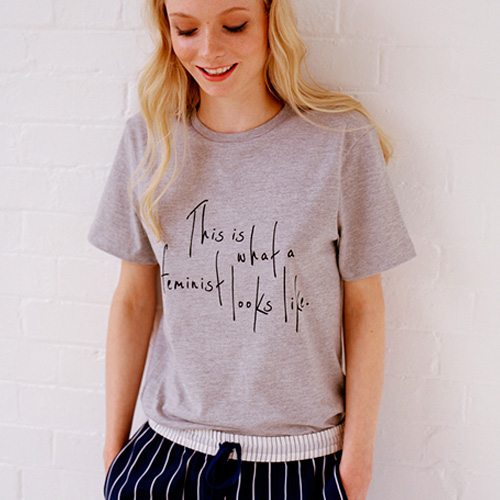

Photo via Elle UK

Feminism as an insult:This usage of the word “feminism” is sadly one of its most common forms.Funnily enough, however, when I googled “insults against feminists,” most of the sites that popped up described how feminism is offensive to society or how feminists insult others. If anything, that just goes to show how deep-rooted the patriarchy in our society is.

The most derogatory use of the word feminist is probably “feminazi,” which compares a movement for equality to a genocide. Whenever a girl starts fighting for her right to speak, she’s deemed a feminazi. Along with feminazi, lots of people (especially teenage boys) like to call girls “feminists” as an insult. She doesn’t shave her legs? She must be a feminist. She’s bossy and outspoken? She’s a feminist. And girls who openly do proclaim themselves as feminists are often paraded with a slew of insults, including lesbian, dyke, bitch, and slut.


In my categorization and gross over-simplification of the uses of the word “feminism,” I excluded a category on how millennials use the word. That’s because teen fall into various categories above. Some teens are raging feminists who wear their hearts on their sleeves, others are the kind who learn about what it is for their history midterm just in time to forget it again. But regardless of where you stand in regards to feminism, it’s important to know what it is and how it’s used, if only to understand the jargon surrounding the equal rights debate.

Are you a feminist? Tell me in the comments below or on social media using #theyouthemisms!

Tuesday, February 17, 2015

Self-sufficiency


My recipe for self-sufficiency, ready to be cooked!
My mother’s favorite thing to tell me is that I’ll never survive on my own if I don’t learn how to cook, clean, and be attractive (yes, apparently this is a life skill). My usual response to that is an eyeroll as I continue to nom on my cold pizza leftovers from last night. The words “cook” and “clean” are all the more cringeworthy when they come from my mother, who has my unrequited love but is also the but of all my teenage angst and thus I must despise any life lesson she tries to instill in me. However, after you take away the doting motherliness, my mom has a pretty good point.
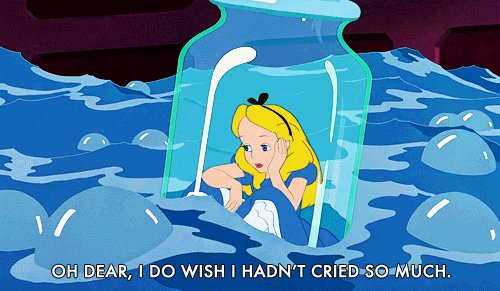
If I had to go live alone right now, I’d drown in my own tears from how pathetic my existence would be.
Originally on weheartit.com, found on allthingsalice.tumblr.com
I can cook. Nay, I enjoy to cook. But I enjoy cooking when I have time for it, and ain’t nobody got the time to cook two or three meals for themselves every day and buy groceries. Oh, wait, but adults have the time.

I can clean. I’m used to vacuuming my room after my mother asks three times (three’s the magic number) and making my bed in the morning. But I wouldn’t clean a whole apartment on my own.

I am tragically un-self-sufficient. I suspect I’m not the only one, wink wink.

Like many other soon-to-be adults, I have the skills necessary to support myself. Unlike many friends, I can cook and clean and I’ve lived on my own for short periods of time. The issue is that I can’t keep up those good habits for very long. It’s like the difference between running a mile and running a marathon. Running a mile is living alone for a week; the first few days are tough, but it’s totally manageable and you don’t break too much of a sweat. A marathon is gruelling, and just as you finish one mile, you realize there’s still 25 to go. The marathon demands a type of endurance that you can’t experience until you're halfway through the run.

How do you learn to run a marathon? You start by running a mile, and then slowly building that up until you’re prepared to try your first marathon. In high school, I started taking more responsibility around the house, whether that be walking the dog after school or doing the dishes after dinner. I became responsible for cleaning my room and bathroom, helpingout with the laundry, et cetera et cetera. I by no means am completely ready to set off on my own, but at least I have the skills to do so. I can run a few miles, now I just got to build it up.

I’m writing about this because the time is descending upon me when I’ll need to start running the marathon and I want to hit the ground running. In half a year I’ll be in college, living on my own. I’m considering an internship in a different state for the summer which means that I’ll have to move out in four months. That’s terrifying as hell, but it’s a necessity. I don’t want to be the person who still lives in their parent’s basement when they’re 25. The more practice I get on with being on my own, the easier it’ll be.

The first few months of living alone I’m positive will be riddled with phone calls home. I don’t know if I’ll be homesick; I’ve never experienced that before. But I’m 100% positive there’ll be phone calls to my mom asking her if light jeans can be washed with the whites and what to do when the air conditioner breaks. I probably won’t truly appreciate the advice my parents have given me over the years until I have to put it to use and I’ll be struggling to remember their own instructions.

I take comfort in knowing that I’m not alone. Virtually all my friends are transitioning into adulthood; just two days ago I was talking to my friend as she signed the lease for her first apartment. At least I’ll be struggling to figure things out with a swath of other people, and we’ll just have to support each other.

Tuesday, February 3, 2015

My Soul Can Be Your Grandmother

Photo and Lettering by Stephanie Smelyansky
I was born with the soul of an Iris Apfel-style granny. While I’m not as outwards with my incessant love for costume jewelry and all things kitsch, I feel like I embody the same subtle IDGAF attitude as my favorite old ladies. That is to say, I frequently didn’t fit in with my own cohort and I’ve rarely cared to remedy that.
 
Let me illustrate my point. When I go to the movies, I habitually make the same two mistakes. The first is that I go to the matinee show, which is crowded with adorable old couples and lacking in any sort of teen scene. The second is my choice in movies. Excluding the occasional broke hipster from a local university in the corner, I’m usually the youngest person in the movie theater by a good forty years. (This was further exaggerated at a showing of “The Exotic Marigold Hotel,” at which I was the only person without a cane/walker/wheelchair.) Quite frankly, I don’t mind; I like my quiet, sassy old people.
 
Deep down I’ve always felt older than I really was. I love anything vintage or reminiscent of earlier centuries. My taste in music and film, while incredibly modern, also includes opera, classical music, and Charlie Chaplin movies. I voraciously read Jane Austen novels and I can’t use technology to save my life. And while my acquaintances might want to go out and party, I often want to stay at home with a small group of friends, playing board games or baking.

It didn’t take me long to come to terms with my premature oldness because I found friends who were just as old at heart. I have friends that go see Woody Allen films with me, obsess over Downton Abbey’s Dowager Countess, decorate their rooms with Dolores Umbridge cats and pause their days for afternoon tea. Our brains run on a common wavelength, one tuned to a radio from the 1950s. We’re not alone in our old youngness.
 
The thing is that being young at heart doesn’t necessarily mean that we were born in the wrong decade. I would die of frustration as a 1950s housewife nor would I particularly like to have grown up during the Great Depression. Us young grannies find inspiration in decades past, whether that be in lifestyle, fashion, or history, and our inspiration can come from a conglomerate of eras. We sometimes just find past time periods to be more relatable than our current one.
 
But being a granny at heart isn’t about old-fashioned family values and moth-ball scented sweaters. It’s about living life at a slower pace and living for an internal pleasure, an internal purpose. The inner granny in me lives for the little pleasures in life, like hearing a bird sing outside my window or smelling a batch of freshly baked brownies. I’m more concerned with doing things because they make me happy rather than to please a crowd, and so are lots of my friends.
 
I think we can all benefit from taking a tip or two from a well-loved grandmother. It might take us 70 years to reach their level of wisdom, but emulating their surprisingly lifestyle doesn’t have to take as long. The lesson all grandmothers teach us is to be comfortable in our own skin and and find happiness in the little things in life. This counteracts the typical culture of mass-consumerism and hate-mongering endemic to many of us today, as pointed out by Rookie Mag Editor Tavi Gevinson. I’m not trying to sound hokey, but the grandmother aesthetic focuses on loving yourself and others. That love’s missing from our lives, and it wouldn’t hurt to emulate it. Besides, why not be a grandmother when you can do it with the effortless class of Joan Didion?


Sunday, February 1, 2015

#SOTU

A pretty important politician gave a pretty important speech in front of a pretty important legislative body last week.
 
A.K.A. the President gave the State of the Union address in front of a newly elected Republican Congress.
 
While all that political mumbo-jumbo might seem useless and boring, it’s still pretty important. As we near (or reach) adulthood, we get the opportunity to vote. We also pay taxes, pay for health care, and actually take responsibility for ourselves as well as others. I therefore believe that it’s important to pay attention to what our politicians are saying since we’ll have to elect them into office and they have to work on our behalf. Besides, some pretty good memes come out of the State of the Union, like this Boehner-Grinch meme.


If the memes didn’t convince you that the State of the Union is important, then maybe Obama’s attention to the youth of America will. The man that won both of his campaigns by winning the hearts of young America is now trying to give all of us a break, whether it be now or in the future.
Some of Obama’s proposals that might interest you:
  • Up to two free years of community college paid by the government
  • Higher minimum wage (all those part time jobs might amount to something now).
  • Paid sick leave (you’ll love this when you’re at your first full-time job and you catch the sniffles)
  • Lower taxes on the middle class. Likely, the majority of you will be part of the ever-growing middle class, and getting a tax break might be good.
  • Equal pay for men and women. It’s about time!


Some of those things sound pretty great, right? But of course most of it won’t ever pass due to the partisan gridlock.
 
The partisan gridlock isn’t just the fault of politicians, however. It’s also the fault of the voter base, one that’s largely uneducated and closed-minded, and that applies to both liberals and conservatives. As soon-to-be voters, we have a responsibility to be politically informed and involved and elect people that represent our interests, whatever that may be.
 
But we can’t just elect people who we think represent our interest; we have to make our interests their interests too. There’s a great bumper sticker that says, “If the people lead, eventually the leaders will follow.” By extension, if the people voice their opinions in a respectful manner, our politicians will have to inevitably follow. There are so many mediums by which we can discuss politics and solutions to current issues, many of which the government is starting to utilize. Instagram, Twitter, and Facebook are all useful platforms for sharing political opinions, and us, the youth, are pretty good at using them. Why not post a picture of a campaign rally on your Insta instead of another selfie?
 
We complain about stuffy adults not caring about our opinion, but politics is our indirect way to take a stance on pressing issues. Interested in the Israel-Palestine conflict? Go to a rally. Passionate about LGBTQ rights? Attend a Pride Parade. Use your social media to voice your opinions. Call or write to your local politicians; trust me, they’re willing to listen because they know that in order to get reelected, they need to win your vote. Politics is a game, but you can put the ball in your own playing field.
 
If you watch the State of the Union, make sure to use #SOTU on your social media as well as #theyouthemisms! I want to make sure to hear your opinions!

Sunday, January 11, 2015

Disposable (cameras)

I went super old school a few weeks ago and converted to the disposable camera. For just $14.99 from Walgreen’s you can purchase a lovely plastic box with film, flash, and no viewing display to take your very own photos.

Disposable camera photography adds a very grungy, imperfect vibe to photos that’s quite a departure from the hyper-clear photography that’s all the rage of DSLR’s. I decided to hop on the bandwagon and document a Model UN trip and the holidays with a disposable I picked up at the drug store. I’m a pretty bad photographer with just my iPhone, so needless to say the majority of the disposable camera photos came out looking like shit(ake mushrooms). It didn’t help that part of the film got damaged somehow and only 19 of my 27 exposures were developed. And of those 19, only 10 produced a viewable image. However, I really like the effect produced on the 10 photos that did work out, so I think I’ll buy a disposable again.
The Kali in her natural habitat

Candid at dinner

Too photogenic

What a hotel room birthday party looks like after everyone's left

Helping each other clean up after being ambushed by silly string

Kali behind some trippy film issues

Don't know who/what this is, but it looks cool

The foggy ballroom at the hotel

Candid ballroom rave shot

Post sinus surgery selfie (I'm covering most of my face because the swelling made me look like a hairless gorilla)

If I had a Christmas card, I'd use this photo

Some tips I have from experience with these cameras:
  • Don’t shoot in dark places as the camera sucks at picking up light unless you have the flash on and you’re super close to your subject
  • Flash is best at about 3-5 ft. away from whoever you’re photographing
  • Don’t drop the camera, expose it to high humidity, or place it under a lot of pressure because you’ll damage the film
  • Candid shots come off the best
  • Buy cameras in bulk on sites like Ebay to save money

I’m no pro at this, but if you google disposable camera photography you can find many great examples and tips, and if you’re really a pro, you can find ways to get creative with your disposable. Just make sure to tag your photos with #theyouthemisms on social media!

Thursday, January 8, 2015

Stoppard's Secret Language

The book I got included several other plays in it. You can get The Real Inspector Hound and Other Plays by Tom Stoppard on Amazon.
I did a book review a while back. You might’ve read it. This is a new book review. If reading isn’t your thing, then make it your thing because reading is a magical activity that everyone from me to your mother will nag you into enjoying

So I’m cheating a little bit because I’m actually reviewing a play that I read. Well, technically two plays. I’m a big fan of Tom Stoppard, a Czech-turned-British playwright who’s portfolio ranges from the script of “Shakespeare in Love” to Arcadia, my all-time favorite play. A Stoppard-obsessed teacher I had recommended that I read Stoppard’s Dogg’s Hamlet, Cahoot’s Macbeth, two one act plays that are meant to be read and performed together.

The crossover between the one acts is obvious. For starters, both plays feature an abridged version of a Shakespeare play (Hamlet and Macbeth) told using original lines from the great playwright himself, albight out of context. However, intermingled with the abridged Shakespearian works Stoppard simultaneously tells the story of the people putting on the play, doing so in a combination of English and a made up language called Dogg. Dogg uses English words but assigns them a new meaning. For example, the phrase “Cretinous git” in Dogg actually means “what time is it,” while in English it’s a particularly creative insult. There’s a circular continuity to Stoppard’s use of Dogg. In the first act, “Dogg’s Hamlet,” there’s a character named Easy who only speaks English but slowly catches onto Dogg. Easy is then reinitroduced in the second act, “Cahoot’s Macbeth,” now only speaking Dogg in front of an English speaking array of characters. He speaks exclusively in Dogg until everyone else “catches” the language and transitions into Dogg as well.

I won’t spoil the plot, but the two plays are hilarious. The layers of plots, ranging from Shakespearian inventions to miscommunications due to the language barrier, are rich in jokes, if one reads between the lines. They’re also a quick read and can be done in a night, making them perfect for the school year. Plus, for anyone into Shakespeare, the puns are plenty.

What really struck me about the play was the language barrier that Stoppard set up. As I mentioned before, Dogg and English use the same words, but give them different meanings. I can’t help but relate that to slang and the stuffy English my parents and teachers use (sorry adults, but you’re out of touch). To illustrate my point, did anyone else have that cringe inducing moment in middle school where the math teacher says the correct answer is 69 and you hear the boys in the back break out laughing? No, just me? Well, that number might have a different meaning to people of different generations, if you know what I mean. We all speak English, but we all speak different versions of English.

How many times have you used the words thot, fleek, or bae, and the adults in the vicinity had no idea what you just said? Clearly, even these cool(er) adults had no idea what any of that slang meant. Again, all of it’s English, just different versions of English. The generation gap creates the same sort of language barrier that Dogg does in Stoppard’s work. Older people even catch onto slang the more time they hear it the same way Stoppard’s character’s catch onto Dogg.

Stoppard was trying to make a lot of points in not a lot of space with Dogg’s Hamlet, Cahoot’s Macbeth, but what I really took away from it was his comments on language. The two plays show that language is largely an arbitrary set of sounds that are assigned a meaning, something we often forget. Languages evolve and change, much as the people who speak them. I think we forget how much of a role we play in changing the phonetic landscape of a language, especially when it comes to slang. Stoppard’s plays were a fresh and funny reminder of both the power and powerlessness of words, all in just seventy pages.

So, I have nothing left to read. Comment with a book recommendation for me, or use #theyouthemisms on social media with your book recommendation so that I can see it!

Sunday, January 4, 2015

New Year, New You

Drawing By Stephanie Smelyansky
Happy New Year, kiddies!

It’s 2015! With that, both 2014 and the holiday season have officially come to a close. The end of the holiday season also means the end of my excessive food consumption (though my waistline hasn’t stretched that much). In general, the end of 2014 for me means the end of my unhealthy habits.

I have a New Years Resolution, something I rarely do, so 2015 must be really special because I’m actually setting a year long goal. This year, I solemnly swear to take care of my body. While 2014 was an awesome year, it was also a really stressful one, full of college applications, AP classes, and drama. Amidst all the chaos, I often neglected my body by not working out, eating like a teenage boy, and sleeping at the oddest times for the shortest periods. Any muscle tone I previously had converted itself to mush and I constantly felt tired. I basically felt like a grandma, and I’m eighteen. Something’s gotta change.

2015 is going to be a big year of change for me. I’m graduating high school and going to college, which is pretty epic and scary. I know college will be a whirlwind of excitement and stress, but to manage the stress, I want to get into a routine of taking care of myself early. As in now. I’ve split this goal into four sections: working out, eating clean, hygiene, and me-time.

The most obvious way to take care of myself is to work out. Duh. For second semester, I’m enrolled in a super intense aerobics class at school for fifty minutes every day. On top of that, I plan on getting a gym membership and going to the gym at least twice a week. I know that I need to work out at a gym because watching other people work out motivates me (also because when I work out at home I end up lying down on the couch with a bag of chips). To diversify my workouts, I’ve come up with this adorable Ryan Gosling jar full of short thirty minute workouts that target various parts of the body. And shirtless Ryan Gosling is wonderful motivation.


The second most obvious way I’m taking care of myself is to eat clean. I have a bit of an unhealthy chocolate addiction that leaves me reaching for a Snickers bar. To combat that, I’ve bought an obscene amount of cacao nibs, which satisfy the chocolate craving without all the preservatives and sugars. In general, I plan on eating more fruits and veggies and less carbs (ahem, pasta). I also want to cook more for myself, partially because I love cooking but also because I get control over what goes into my food. Food should energize me, not just sustain me until my next meal.

Now hygiene...I promise I’m already a hygienic person! I floss, I shower regularly, the works. By hygiene, I mean that I want to take better care of myself from the outside as well as the inside. This means taking an extra few minutes at night to massage some lavender oil or body lotion into my skin or blow drying my hair rather than going to bed with wet hair. I want to spend more time on the little things that make me feel good on the outside as well as the inside.

Finally, I want to spend more time on myself. Between schoolwork and hanging out with friends I forget to take a quiet moment to myself. This year, I promise myself to find time to light a scented candle, make a cup of chai, and curl up with a good Jane Austen book. If I want to do something, like see a movie or go to a museum, I won’t wait for others to come with me. I’ll take myself on a date and I’ll get some good sushi for dinner while I’m at it!

There you go. That’s my New Year’s resolution. I doubt I’m the only girl out there that just wants to better care of herself. With that, I want to know what your resolutions are and how you’re achieving them! Post a picture on twitter or instagram and tag it with #theyouthemisms so I can see all your resolutions!